Currently Empty: £0.00
Moving to Italy in 2027? Tax Planning Should Start Before the Move
Moving to Italy in 2027? Tax planning should start before the move. When an EU or UK family is considering relocating to Italy, the questions


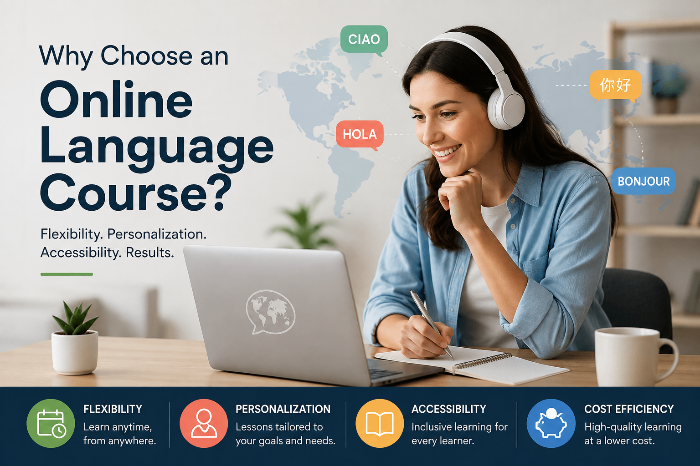
For many people, including myself, moving to online learning was not initially the first choice, but rather a practical secondary option.
I worked as an in-person teacher for many years. First, I taught at several language schools in Milan, and later I managed my own Italian language school from 2005 to 2020. I was deeply accustomed to the traditional physical classroom. When the pandemic arrived, I was forced to close my physical school and transition all my teaching activities online. Although I had always been interested in educational technology and innovation, I strongly believed that the human interaction created inside a physical classroom could never be replaced.
However, direct experience proved my initial assumptions wrong right from the start.
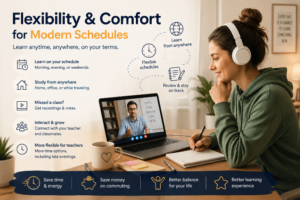 Online language courses offer a degree of flexibility and convenience that fits much better with the demands of modern life. For adult learners who must balance work, family, and personal obligations, finding the extra time and energy to commute to a physical school is often difficult. This is particularly true for people living in large metropolitan areas or in locations without language institutes near their home or workplace.
During my years managing a school in Milan, I noticed a consistent pattern. Students were able to attend classes regularly only for short periods, usually when they had just arrived in Italy and had fewer obligations. After two or three months, increased work commitments, family duties, public transportation delays, and bad weather caused many students to miss classes. When you miss too many in-person lessons, catching up with the rest of the group becomes very difficult. As a result, many students become discouraged and drop out entirely.
An alternative solution is hiring a private tutor to come directly to your home. However, home visits are significantly more expensive and generally limit the learning experience to individual lessons, removing the opportunity to interact with other students.
Online courses solve these structural problems by allowing you to study from wherever you choose. You can attend your lesson right after work, while traveling, or on days when you feel tired and prefer not to leave your house. Furthermore, if you miss a live session, you can easily receive the video recording and all the lesson notes. This ability to review the material and stay on track with the class is a major advantage that traditional in-person courses simply cannot offer.
This convenience also benefits the teacher. Working remotely creates a much more relaxed environment and allows teachers to offer more flexible schedules, including late evening classes. When I managed my physical school, meeting the demand for late evening courses was always a major challenge because it was difficult to find teachers willing to travel and stay late at the facility. Online platforms solve this difficulty completely.
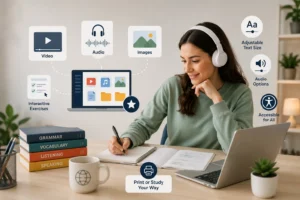 In an online course, teachers can utilize a much wider variety of educational resources, including audio tracks, video clips, digital images,and interactive exercises. These resources make lessons more dynamic and engaging. Because teachers are not restricted to a single printed textbook, they can easily modify the curriculum and adapt lesson plans whenever necessary to meet the specific needs of the class.
Designing original teaching materials has always been one of the parts of my profession that I enjoy the most. Moving to online teaching opened up many new creative possibilities for me. Having taught online for six years now, I have built a comprehensive library of original learning materials for all proficiency levels. Having these digital assets organized allows me to quickly select the most suitable resources for each student or group and adapt them whenever required.
Digital learning materials also significantly improve accessibility for learners with specific needs. The format of digital documents can be modified easily: text size can be increased for students with low vision, and audio settings can be adjusted for students with hearing difficulties. Paying attention to these practical details creates an inclusive learning environment where every student can learn comfortably.
At the same time, using digital materials does not mean that students must completely abandon traditional learning methods. All digital course materials can easily be printed for those who prefer working with physical paper. In fact, I frequently recommend printing exercises for beginner students, because the physical act of handwriting plays an essential role in memorizing new vocabulary and understanding grammar structures when starting a new language.
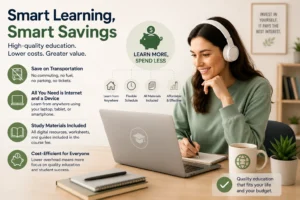 Online learning allows us to combine high-quality instruction with significant cost savings for students. When you choose an online course, you eliminate many indirect expenses, making language learning far more sustainable in the long term.
First, you save money on transportation. You do not need to use a car, pay for fuel or parking, or buy public transport tickets to travel to a physical school. You can easily attend your class from home, your office before or after work, or even during your lunch break. Additionally, if you prefer private lessons, you avoid paying the extra travel fees that teachers usually charge when coming to your home or office.
To participate, you only need a reliable internet connection and a digital device. For group courses, using a laptop or desktop computer is recommended, as a larger screen allows you to clearly see all group members, view shared materials, and interact smoothly with the class. However, if a computer is temporarily unavailable, you can also join using a tablet or a smartphone. For individual lessons, a smartphone is often completely sufficient, provided your internet connection is stable.
Second, online courses help you save on learning materials. All course resources, including digital worksheets, exercise guides, and authentic learning materials, are fully included in the course fee. Students do not need to buy expensive commercial textbooks or printed dictionaries. Furthermore, I am always happy to provide complimentary supplementary materials when a student needs extra practice, as well as recommend free, high-quality online resources for those who want to explore specific topics in more detail.
Finally, these financial benefits extend to the teacher as well. By eliminating the high fixed overhead costs of operating a physical facility, I can focus my energy directly on educational quality. Reduced administrative expenses allow me to dedicate more time to lesson preparation, curriculum development, and personal attention for every student, resulting in a higher overall quality of instruction.
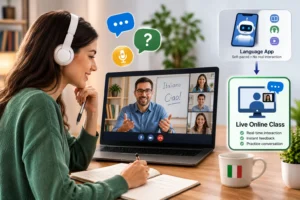 The quality of human interaction is perhaps the main concern for people considering an online language course. Many prospective students worry that online learning feels cold, distant, or impersonal, and that it is difficult to build a real connection with the teacher and classmates.
I completely understand this concern because I held the exact same belief before I began teaching online. Today, my perspective has changed entirely. When someone expresses strong doubts about online interaction, I never try to force a change of mind. However, when a student is open-minded and willing to try, they almost always discover how engaging, collaborative, and personal a virtual classroom can actually be.
It is essential to understand that a live online course with a professional tutor is fundamentally different from using a language learning app. As a passionate language learner myself, I use several apps and find them very helpful. However, apps alone are not enough. Without professional guidance, learners can easily get lost in the vast amount of information on the internet, where materials are not always accurate and explanations can sometimes be misleading. A qualified teacher helps you select the right resources and structures your learning pathway effectively.
Similarly, live instruction offers a different experience compared to pre-recorded online courses. Pre-recorded courses certainly have great advantages: they are more affordable, offer maximum flexibility to study at any time, and provide structured, self-paced content. In fact, because many of my students have requested them, I do not rule out the possibility of creating pre-recorded courses in the future as a complementary learning resource.
However, pre-recorded materials have a structural limitation that they cannot overcome: they lack immediate, real-time interaction. While you can use pre-recorded video lessons to strengthen your grammar or review specific topics, they cannot replace live practice. Live online classes combine the convenience of digital tools with authentic human communication, giving you the immediate opportunity to ask questions, practice conversation, receive instant feedback, and interact directly with your tutor and group members.
 Regarding the role of the teacher, online learning gives you a great opportunity to get to know your instructor. While large language schools and institutions select and monitor their teaching staff carefully, contacting and meeting your specific tutor before the course starts is usually much more direct and immediate when working with an independent professional.
I always meet with prospective students before they enroll, not only to assess their language proficiency, but also to get to know them and allow them to get to know me. Personal rapport between tutor and learner is essential; a solid mutual understanding is the foundation of any effective learning journey.
In fact, live online group courses can often be even more dynamic and enriching than traditional in-person classes. As a teacher, I find it fascinating to connect with students from all over the world right from my home office. In a physical language school in your home country, you typically meet classmates of the same nationality, often with very similar backgrounds and goals. While this can feel comfortable at first, it can sometimes become repetitive over time.
In-person language schools based in Italy present a different setting, but school managers face real operational constraints when forming balanced groups. Balancing schedules, levels, and classroom availability makes it difficult to ensure every group dynamic works smoothly.
Online classes significantly reduce these practical limitations. In a virtual classroom, you have the unique opportunity to meet diverse individuals living in different parts of Italy and around the globe—working professionals, university students, and retirees. Hearing their varied perspectives and learning about different lifestyles enriches every lesson. Over the years, many of my students have studied together for long periods and developed genuine friendships, remaining in touch or even meeting in person in Italy.
Ultimately, the specific platform or tool you use matters far less than the quality of the human connections you build through it. If you are curious to discover a flexible, highly interactive, and personalized way to master a new language, the best step is simply to begin. I look forward to welcoming you to our learning community.
Moving to Italy in 2027? Tax planning should start before the move. When an EU or UK family is considering relocating to Italy, the questions
For many UK Airbnb and holiday-rental hosts, the best guest recommendations are not copied from a guidebook. They come from local knowledge: the quiet lane


This article was originally published on The Bridge to Italy. I took the Italian theory test yesterday for the Patente B and passed on my

The Italy Golden Visa, officially known as the Investor Visa for Italy, is Italy’s investment-based residence programme, introduced by the 2017 Italian Budget Law. The programme allows


Buying Property in Italy: What the EU’s New Energy Rules Mean for Foreign Buyers Buying Property in Italy: What the EU’s New Energy Rules

Things to know Renting a home in Italy can initially appear complex, particularly for those who are unfamiliar with the country’s legal framework. Yet understanding